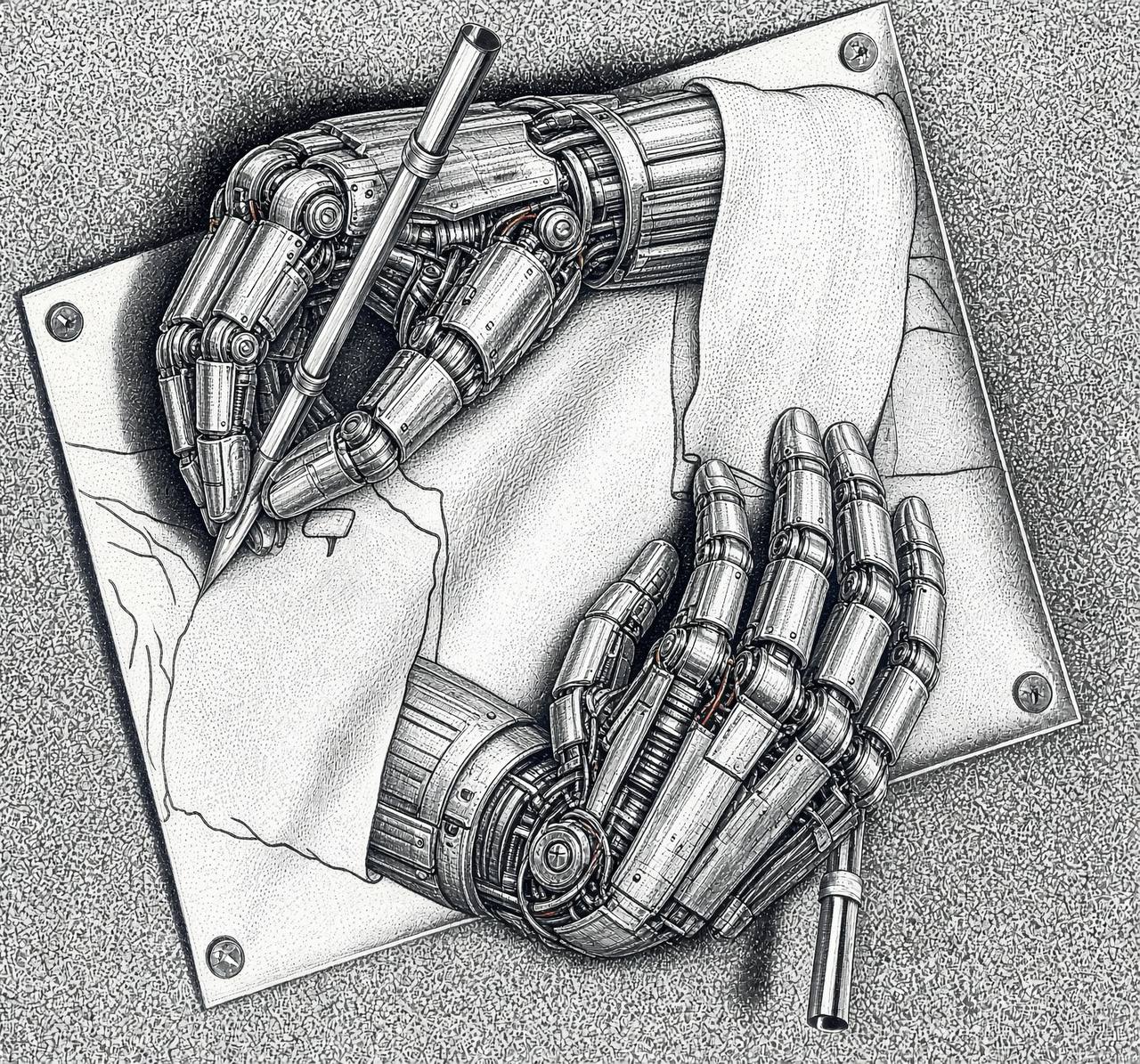
Adapted from a guest lecture Vance Crowe gave to Dr. Kevin Folta's class at the University of Florida, September 24, 2026.
Most of an adult professional's working life comes down to four tasks: copying and pasting information, searching for things, and scheduling meetings. If you have never had a corporate job, that probably sounds wrong. Surely the work is more interesting than that. But watch what people actually do all day. They take information from one place and move it to another. They compile data from experiments or projects into reports. They hunt through folders and inboxes trying to remember where a file lives. They send emails that say "here are my available times" and wait two days for a reply.
I'd estimate 60 to 80 percent of human attention at work goes to those four tasks. Copy. Paste. Search. Schedule.
David Graeber wrote about this in Bullshit Jobs. His argument was that as computers got better, a 40-hour job often shrank to about 10 hours of real work, and people spent the other 30 hours keeping themselves busy. Meetings they had no authority to change anything in. Reports nobody read. I've been inside corporate America and inside large international organizations, and I can tell you this is why so many people in adult professional jobs don't look or act fulfilled. Their intellect is being spent on moving information around.
AI agents are built to do exactly this work. Not to answer your questions, but to go out into the digital world and act on your behalf. Fill out the apartment application. Fill out the insurance forms. Have your agent talk to my agent and find the lunch date that works, instead of the six-email volley we do now. Reorder the diapers before you run out, and time the delivery for when someone is home.
None of this is speculative. It is the least controversial prediction anyone can make about AI right now. The copying, the pasting, the searching, and the scheduling are the first things to go, because they were never really human work in the first place. They were work we did because information was scattered and machines couldn't read it.
Here is the part I told the students that I want to say to every young person: this is the biggest opportunity that has been presented to a generation in my lifetime.
You are about to enter a workforce alongside people who have spent 20 or 30 years doing copy-paste-search-schedule work. That work shaped them. When the tools change, they have to unlearn decades of habit. You don't. You arrive with nothing to unlearn.
It used to be that you graduated, showed up at some big firm, and made the coffee for two years before anyone let you touch real work. That ladder is gone. If you can imagine something and you know how to work with AI and agents, you can build things that used to require a staff, an advanced degree, or privileged access to data. I described it to a friend recently as feeling like flying on a magic carpet. I can build anything I want now. A college student who puts in the reps has the same carpet.
And the advantage compounds in small, unglamorous places. Show up at your coffee shop job and say "I used AI to build a better way to do the scheduling." Solve a problem in your parents' business that nobody has been able to touch. Build yourself a system that fills out the stupid applications that waste your time. The people above you are walking past these problems every day. If you are the one who fixes them, that gets noticed.
The trick sounds like a joke, but it works: use AI to learn AI. Go to an AI and type "I want to build an AI agent, what should I do?" Then say "ask me ten questions about myself so you know how to build for me." Then keep asking "what should I do next?" You will learn about security, about where to store your data, about doing it cheaper, all by staying in that loop between asking, doing, and seeing what worked.
Then save your instructions. The first two weeks, what you've taught your AI will be thin. But every time you tell it "do things this way," "remind me on these days," "here is how to reach that information," you are stacking instructions. Store them somewhere like GitHub. By the time you graduate, you could have two or three years of accumulated instructions, an agent that already knows how to operate for you. Then you point it at your employer's problems.
One caution to carry with all of this. AI will be able to create almost anything, but it has no preferences. It has no judgment about what ought to exist. That comes from humans, and it will become one of the most valuable things a person can have.
So while you learn the tools, also develop taste. Not just opinions, but a real understanding of why one thing is better than another. How color works. How sound works. What makes food worth eating or a story worth telling. The people who thrive won't be the ones who merely operate the machine. They will be the ones who know what to ask it for.
The copy-paste-search-schedule era is ending. For people who spent their careers inside it, that is disorienting. For people just starting out, it is the widest open door I have ever seen.